


SOVEREIGN NATION

Preserve Our Legacy
Join us in celebrating the rich traditions and culture of the Albaamaha-Alibamu Nation.


“I did not rise to be seen—I rose so my people would never again be erased.
Our identity was never lost; it lived in our bloodlines, our memory, and our will to remember.
What history tried to break can be restored by truth.
I walk for those who came before me and for those not yet born.
We are not reclaiming the past—we are protecting the future.
A Nation does not begin with recognition; it begins with remembrance.
True strength is not found in domination, but in the courage to stand as who we are.”
I stand not as owner of a people, but as a servant of remembrance.
The vision that gave rise to the Albaamaha-Alibamu Indian Sovereign Nation was born from ancestry, responsibility, and the quiet call to restore what history attempted to silence. This work is not about power, position, or recognition—it is about continuity.
Our people have always existed. Even when names were changed, records altered, and identities misplaced, the spirit of our lineage endured through families, memory, and resilience.
This Nation was formed to protect that continuity—to ensure that our children know who they are, where they come from, and why their identity matters.
I carry this vision with humility, guided by ancestors, strengthened by community, and committed to peace. May what we build together stand not for a moment, but for generations.
— Empress PureFire Katrina

Empress,
Clan Mother, Ambassadors,
Council Elder,
Spiritual Leaders, and Mico (Chiefs)
Governance Structure
Leadership of the Nation
The leadership of the ALBAAMAHA-ALIBAMU INDIAN SOVEREIGN NATION exists in sacred service to the People, the Ancestors, the Creator, and future generations.
Our leadership is not based on domination but on stewardship, spiritual responsibility, accountability, and the protection of the Nation’s sovereignty and its citizens.
Each leader is called to serve with honor, truth, and discipline, upholding:
Natural Law
Creator Law
Indigenous self-determination
Our governance structure reflects balance between:
Spiritual Authority
Governing Responsibility
Community Service
Ancestral Law
Leadership Roles
Office of the Empress
The Empress serves as the highest spiritual and governing authority of the Nation.
This sacred office is entrusted with:
Safeguarding the sovereignty of the Nation
Upholding Indigenous Law and Spiritual Law
Representing the Nation in official matters
Protecting the rights of the People
Providing vision, guidance, and final authority in matters of national importance
This role is one of servant leadership, guided by ancestral covenant, spiritual calling, and divine responsibility.
Clan Mothers
Clan Mothers serve as the protectors of lineage, family, and cultural continuity. Their responsibilities include:
Safeguarding the welfare of women, children,, and families
Advising leadership on matters affecting the clans
Preserving cultural values and ancestral teachings
Supporting unity and balance within the Nation
Micos (Chiefs)
Micos serve as traditional chiefs and regional leaders responsible for:
Maintaining order and discipline within the Nation
Enforcing Tribal Law and custom
Representing community interests
Supporting the protection of land, people, and sovereignty
Tribal Council of Elders
Elders are honored as the living libraries of the Nation.
The Tribal Council of Elders acts as an advisory and governing body that supports the Empress by:
Drafting and reviewing national policies
Overseeing humanitarian programs
Protecting tribal integrity
Supporting enrollment and registry matters
Serving as guardians of justice, balance, and fairness
Council decisions are made through prayer, deliberation, and accountability.
Spiritual Council / Elders Council
The Spiritual Council provides ancestral wisdom and spiritual oversight. Their responsibilities include:
Preserving sacred teachings
Providing spiritual guidance to leadership
Supervising ceremonies, naming rites, and ancestral observances
Maintaining harmony between the People and Natural Law
Ministers & Community Servants
Spiritual Leaders and community servants carry out the daily works of service, including
Outreach and humanitarian aid
Identity clinics and registry assistance
Youth, family, and elder programs
Teaching, counseling, and community restoration
These leaders are trained in integrity, discipline, compassion, and service.
Leadership Principles
All leaders of the Nation are guided by these sacred principles:
Truth before Power
Service before Status
Protection before Profit
People before Politics
Spirit before Ego
Leadership is a responsibility—not a position.
Appointment & Accountability
Leaders are:
Recognized through service, lineage, spiritual calling, and works
Held accountable under Tribal Law and Spiritual Law
Any leader found guilty of abuse of power, corruption, or betrayal of the People is subject to removal.
Message to the People
We lead not for control —
We lead for restoration.
We rise not for pride —
We rise for the protection of future generations.

Sovereign Status
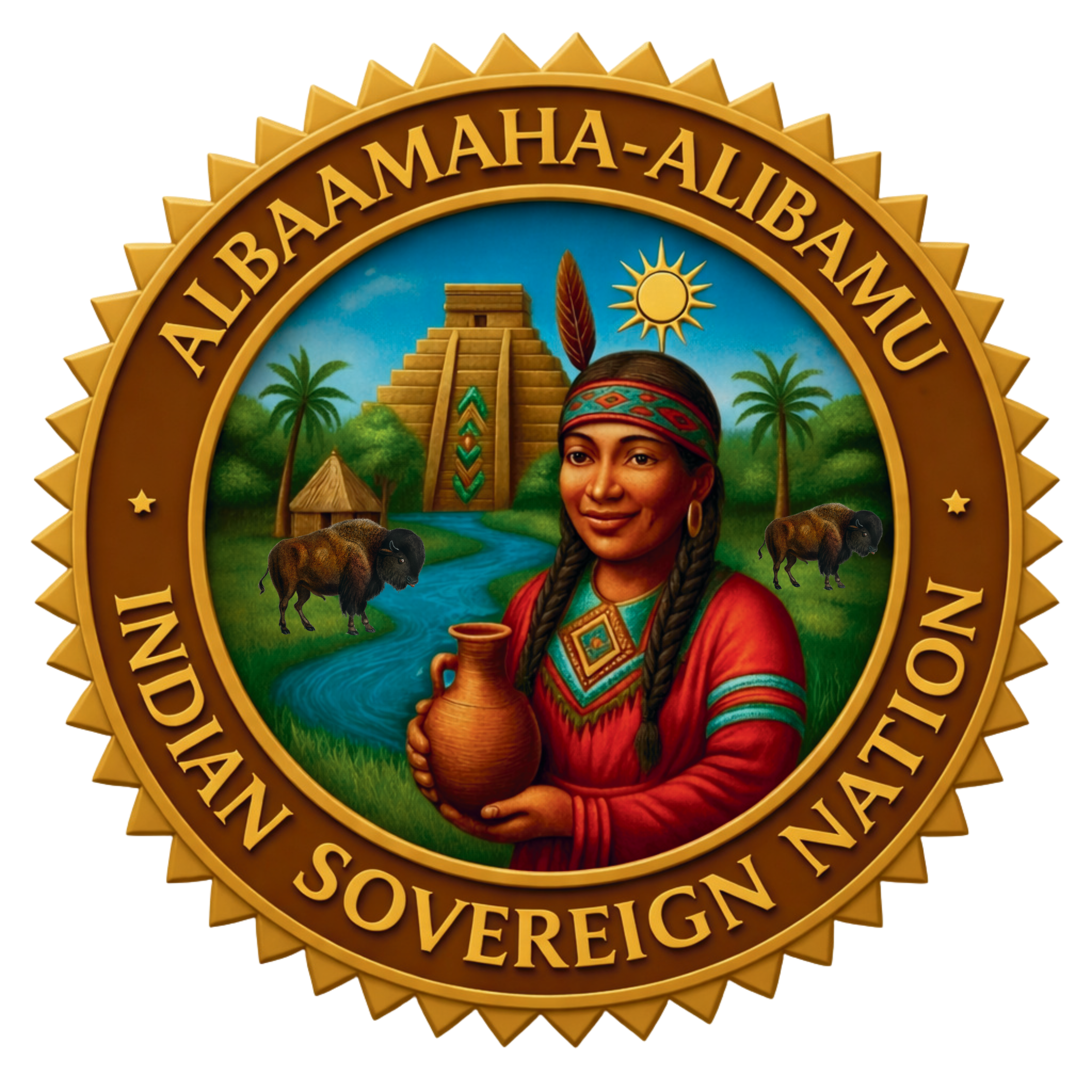
Official seal and foundational law imagery of the Albaamaha Nation representing sovereignty and ancestral governance.
The ALBAAMAHA-ALIBAMU Nation operates as a self-governing spiritual and Indigenous body under Natural Law, Ancestral Law, and the inherent right of self-determination. Our sovereignty is derived from our original identity as a People, our ancestral continuity, and our lawful declaration of nationhood.
The laws of the Albaamaha Nation exist to protect the People, preserve peace, honor the Earth, and restore rightful identity for present and future generations.
Our laws exist to protect the People, preserve peace, honor the Earth, and restore rightful identity. All governance within the Nation is founded upon truth, balance, accountability, and service.
Natural Law
Ancestral Law
Indigenous Rights
Tribal Governance
Trust & Ecclesiastical Authority
Our laws exist to protect the People, preserve peace, honor the Earth, and restore rightful identity. All governance within the Nation is founded upon truth, balance, accountability, and service.
Then underneath, you can list:
Natural Law
Ancestral Law
Indigenous Rights
Tribal Governance
Trust & Ecclesiastical
Authority
Indigenous Self-Determination
The Nation affirms the inherent right of Indigenous Peoples to:
Self-identify
Govern internally
Preserve spiritual and Cultural practices
Maintain sacred lands and traditions
Restore lineage and identity
This right is natural, not granted by outside authorities.
Governance Authority
The Nation is governed through:
The Office of the Empress
The Tribal Council
The Elders & Spiritual Council
Ministerial & Administrative Offices
Governance is exercised in:
Justice
Peace
Accountability
Restoration
Service to the People
Trust & Ecclesiastical Authority
The Nation also operates through:
Sacred Trust Administration
Ecclesiastical Authority
Ministerial Jurisdiction
These protect the spiritual, humanitarian, and identity work of the Nation and ensure lawful separation from foreign civil systems where applicable.
Jurisdiction & Protection
The Nation asserts jurisdiction over:
Its internal membership
Its registry and identity records
Its spiritual and humanitarian operations
Its cultural and ancestral affairs Our law exists to protect the People from exploitation, corruption, and identity theft.
Purpose of Law
Law within the Nation is established:
To restore the People
To protect future generations
To ensure justice and balance
To preserve ancestral covenant
To maintain peace and order
Declaration
We are governed by:
Truth over deception
Spirit over ego
Protection over profit
Unity over division
Restoration over control.
Public Notice:
The ALBAAMAHA-ALIBAMU Nation operates as a spiritual and cultural self-governing body. This page is presented for educational, cultural, and humanitarian purposes and does not constitute legal advice or claim jurisdiction within any external government system.
Indigenous Rights
International Declarations
Treaties & Proclamations
Private Law Notices

For all record updates, corrections, or registry assistance, tribal members may contact us at:
albaamahaalibamuindian@gmail.com
All requests are handled confidentially and in accordance with Tribal Law and Member Privacy Protection.

.png)

Our Stories


ALBAAMAHA-ALIBAMU: Embracing Sovereignty and Sacred Culture


Preserving Albaamaha-Alibamu Traditions: A Spiritual Journey


The Role of Ceremony in Albaamaha-Alibamu Spiritual Life

WE HONOR YOU

We honor you for visiting our sacred space. Our Tribe stands on the strength of our ancestors, the wisdom of our elders, and the spirit of our people who continue to walk with purpose. Here, we protect our heritage, celebrate our sovereignty, and uplift the teachings that guide our way of life.
This site is a doorway into our story—our culture, our traditions, and the blessings of our community. We invite you to learn, connect, and walk this journey with us in respect, unity, and truth.

Sacred Teachings & Affirmations

Introduction This page shares the sacred words, meanings, and spiritual truths that guide the ALBAAMAHA -ALIBAMU INDIAN SOVEREIGN NATION. These teachings come from Creator, Mother Nature, and the Ancient Ones whose blood, breath, and memory flow through us. Each word carries frequency, law, and ancestral authority. We speak not merely to define— but to restore, activate, and remember who we are.


Explore the Collection
Wear your style proudly with our official ALBAAMAHA apparel. From cozy hoodies to sporty tees, each item carries the spirit of creativity and confidence.